
Product
DCIMate
A software platform for data center control and optimization that combines energy-aware workload scheduling, autonomous power management, and a thermo-fluid dynamic Digital Twin. Reduce consumption, improve PUE, and prevent thermal hotspots, while maintaining SLA compliance, with results measured on real production-class hardware.
Validated end-to-end on real hardware
DCIMate's scheduling and power-management stack runs autonomously on a production-class Kubernetes cluster of eight servers spanning four hardware generations (Intel Xeon and AMD EPYC, 472 physical cores). Every energy figure below is measured at the wall with facility-grade BMC/IPMI power metering, not simulated, and not estimated from CPU counters.
Energy-aware placement: the same work for a third less energy
Identical jobs cost very different amounts of energy depending on which server runs them, on our cluster up to 2× for compute work and 6× for memory-bound work. Stock schedulers are blind to this: they place work wherever CPUs are free. DCIMate routes each job to the node that completes it for the fewest joules.
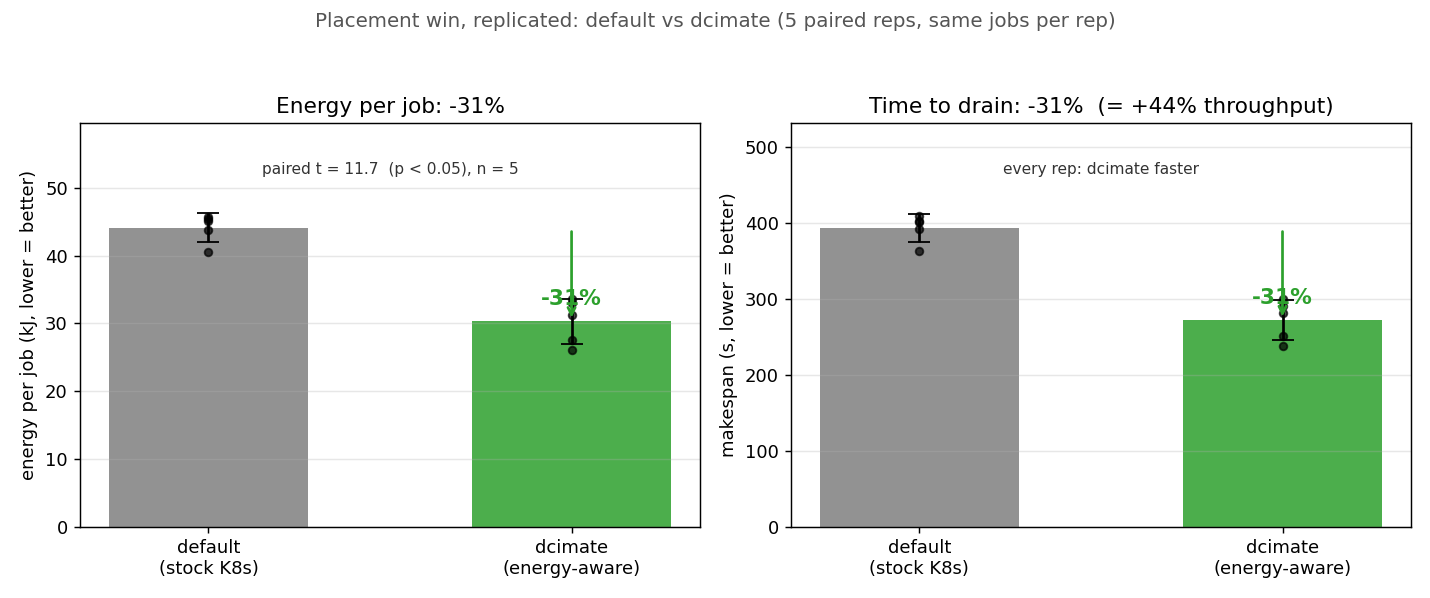
Draining the same fixed backlog of AI-inference jobs through stock Kubernetes and through DCIMate, on the same hardware, placement delivered 31% less energy per job and 44% higher throughput, replicated over five paired runs, winning every time (p < 0.05). Average power stayed flat: the cluster simply finished the work sooner. No new hardware, no performance trade-off.
Safe power-off: removing the idle floor
A modern server drains roughly half its peak power while doing nothing, 200–300 W per node on our cluster, and CPU frequency tuning recovers almost none of it (we measured ~0% at the wall). The only way to reclaim those watts is to power the machine off. DCIMate consolidates work onto efficient nodes and autonomously powers off the machines it frees, waking them within minutes when demand returns. On a four-hour realistic demand cycle this cut measured facility energy by 52%.
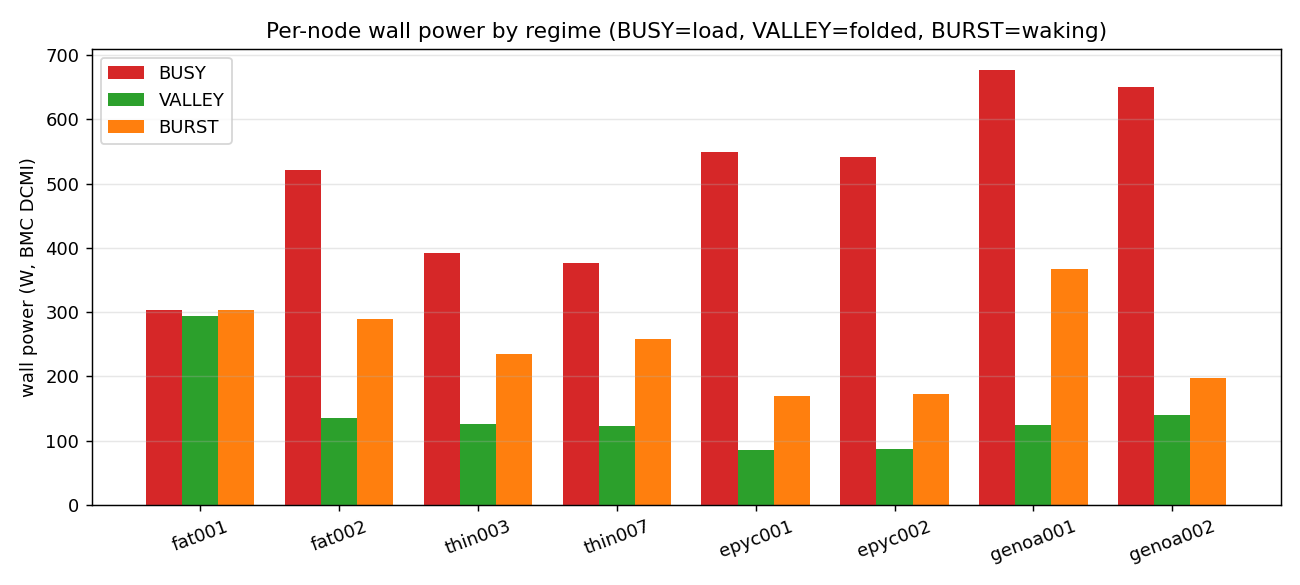
The hard part, and the part DCIMate is built around, is knowing when powering off is safe. Done naively, it backfires: we measured that reacting to every short dip in demand makes the cluster worse on both energy and service quality, cycling hardware and starving capacity. DCIMate's hysteretic control tells a genuine lull from a brief dip: under load it performs zero power-offs, and it folds the cluster only when idleness is sustained, so it is never worse than doing nothing.
What it means for the bill
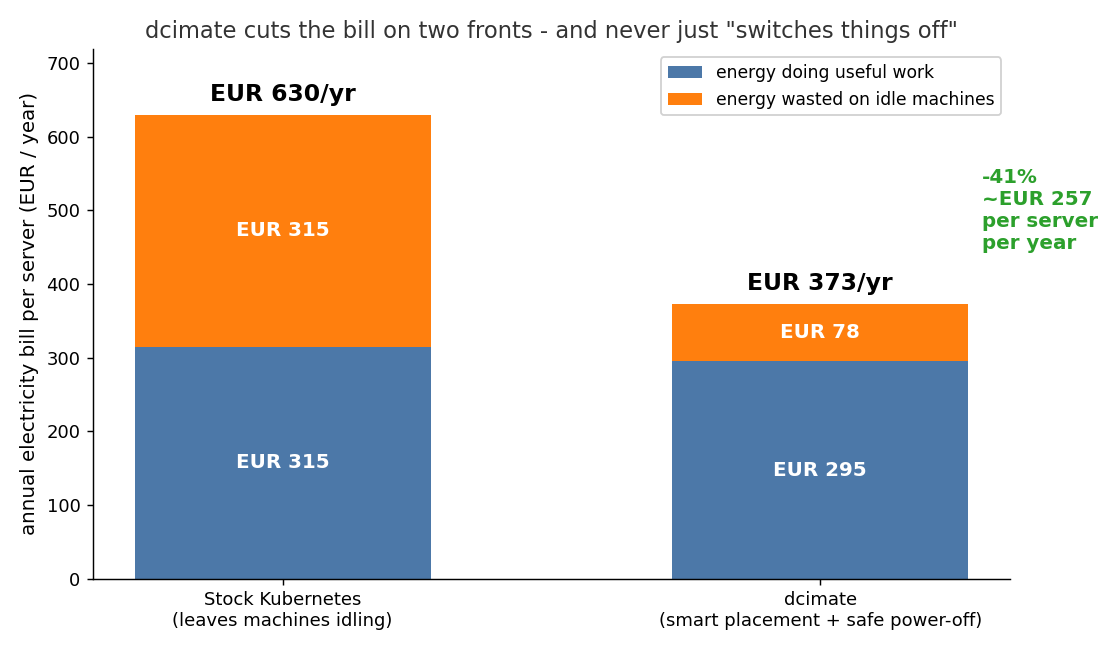
Feeding the measured power states into an annual cost model (a modeled projection, clearly distinct from the measurements above): on a typical, partly-idle cluster the two levers together cut the electricity bill by roughly 41%, about EUR 257 per server per year at EUR 0.25/kWh, scaling nearly linearly to fleets of thousands of machines, and growing larger in sites with high cooling overhead, because a powered-off server also stops producing heat.
Want these numbers on your cluster?
We start from your own metering, not a benchmark. Tell us what you run.
A physics-based model of your data center
At the core of DCIMate is a digital twin that reproduces the thermo-fluid dynamic behavior of the physical environment. It combines discrete CFD simulation for airflow and heat distribution and cooling system models representing CRAC/CRAH units and ventilation systems.
This makes it possible to simulate temperature evolution at the rack level and evaluate the thermal impact of variations in computational workload, in near real time.
Fast inference with a surrogate model
Full CFD simulations are too computationally expensive to run continuously at runtime. DCIMate employs a surrogate model trained with machine learning that learns airflow behavior from both physical simulations and real-world data.
The result is near real-time estimation of the thermal field while maintaining good accuracy with respect to the physical model. The surrogate is periodically updated using new operational datasets.
Energy-aware workload scheduling
The thermal model is integrated with a workload scheduling pipeline that jointly optimizes IT systems and cooling infrastructure. The system evaluates the thermal impact of different workload distributions via the digital twin and selects the configuration that minimizes total energy consumption, cooling utilization, and thermal hotspots.
Unlike traditional DCIM solutions, DCIMate simultaneously considers server workload, rack temperatures, airflow distribution, and cooling efficiency, enabling joint optimization that was previously not available.
Scheduling, live
Your scheduler counts cores. It has never seen a watt.
The same 30 llama.cpp jobs, the same eight machines, two schedulers. Both clusters below are Kubernetes control planes running in your browser. The only difference is who binds the pods.
Stock K8s
backlog 30- genoa001genoa · 64cparked306 W
- genoa002genoa · 64cparked306 W
- epyc001epyc · 128cparked211 W
- epyc002epyc · 128cparked211 W
- fat001fat · 36cparked308 W
- fat002fat · 36cparked308 W
- thin003thin · 24cparked258 W
- thin007thin · 24cparked258 W
waiting for jobs
- Done
- 0/30
- kJ / job
- –
- Drained in
- –
DCIMate
backlog 30- genoa001genoa · 64cparked306 W
- genoa002genoa · 64cparked306 W
- epyc001epyc · 128cparked211 W
- epyc002epyc · 128cparked211 W
- fat001fat · 36cparked308 W
- fat002fat · 36cparked308 W
- thin003thin · 24cparked258 W
- thin007thin · 24cparked258 W
waiting for jobs
- Done
- 0/30
- kJ / job
- –
- Drained in
- –
Measured on the real cluster
Same jobs, same hardware. DCIMate sent prefill to the genoa nodes and decode to the thin nodes, and parked the machines that are worst at both. This run: – energy per job. On the campaign it replays:
- Energy per job
- −9%
- Time to drain the backlog
- −7%
- Throughput
- +8%
On the larger 40-job run the gap widens to −31% energy per job. How it was measured →
Placement policies and the job mix replay the measured 30-job A/B from the validation cluster (wall power via IPMI). Job durations and node power come from the twin's simulator, calibrated on that run. Time runs about 20× faster than real time. Kubernetes runtime: webernetes (Apache-2.0).
From data to action
DCIMate operates through a continuous processing pipeline. Sensor data, temperature, airflow, energy logs, and server utilization, is normalized and fed into the digital twin. The surrogate model computes temperature distribution, predicted thermal evolution, and effects of potential workload redistributions within seconds.
The scheduling algorithm then evaluates multiple scenarios and selects the configuration that best balances energy efficiency, thermal stability, and SLA compliance. The system generates workload balancing recommendations, ventilation policies, and optimal cooling configurations. In advanced mode, it operates in closed-loop control, integrating directly with existing DCIM or BMS systems.
Interactive 3D viewer (sound on)
DCIMate includes an interactive 3D viewer based on Three.js that represents the data center in near real time: rack layout, room topology, airflow paths and particles, and temperature fields.
The interface facilitates understanding of thermal phenomena and communication of results to operators and non-technical stakeholders. Operators can observe real-time rack temperatures, airflow patterns, and the impact of optimization decisions, all in an intuitive 3D environment.
Intelligent sensor nodes
Each ESP32-based sensor node integrates a low-power microcontroller with Wi-Fi/Ethernet connectivity and hardware interfaces for sensors (I2C, SPI, GPIO). The firmware runs a continuous cycle of sensor data acquisition, local filtering and normalization, and transmission of processed data to the DCIMate platform.
The firmware includes a lightweight embedded agent inspired by zclaw, which exposes hardware functionality through high-level commands. The agent acts as a software interface between DCIMate and the physical sensors, enabling sensor querying, threshold configuration, and firmware updates.
Built for energy-efficient infrastructure
DCIMate is designed for enterprise data centers, HPC infrastructures, edge data centers, and cloud and colocation facilities, wherever energy efficiency drives operational cost and sustainability.